water — PBR water surface and caustics
English | 日本語
Overview
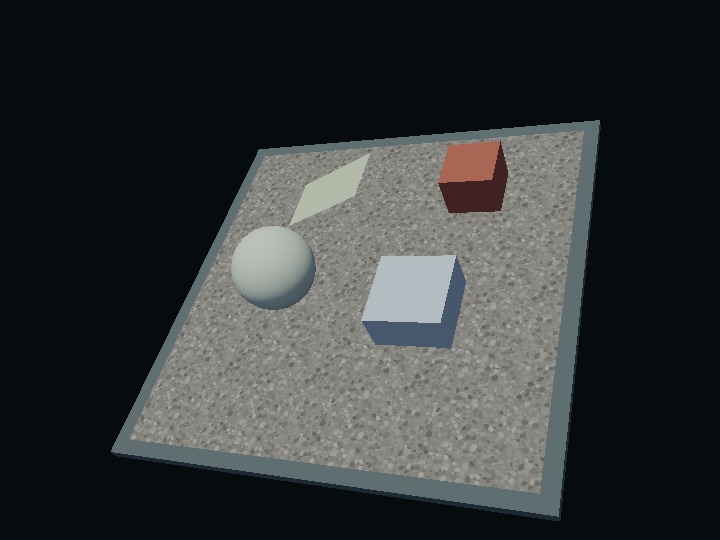
A small integration example applying caustics to a floor, sphere, box, and slope, with an independently switchable water surface. WaterBody stores the water region, waves, absorption, and registered receivers. ComputeEffectPipeline.setWater() manages GPU resources and composition order. Connect WaterBody to the standard PBR pipeline to display water and caustics.
Run
Open water.html from an HTTP server serving the repository. Use a WebGPU browser on localhost or HTTPS. Enable caustics and water separately, select receivers, move the sphere, animate waves, or change caustic quality. Drag to orbit and scroll to zoom. The verification button reads back GPU images and compares them when selected.
Connect water
Caustics use a vertical downward directional light. Set lightDirection: [0, -1, 0] and shadow: { directional: { up: [0, 0, 1] } } when creating the pipeline. PbrRenderer accepts the same settings in its pipeline options.
import WaterBody from "../../webg/WaterBody.js";

const water = new WaterBody({
  origin: [0, 0, 0], width: 8, depth: 8, extent: 20,
  surfaceHeight: 2, amplitude: 0.15,
  waveMix: [1, 0.4, 0.2], absorption: [0.09, 0.035, 0.025]
});
water.addReceiver(floorShape);
water.addReceiver(objectNode, { children: true, strength: 0.7 });
await pipeline.setWater(water, {
  surfaceEnabled: true, causticsEnabled: true, quality: "low"
});
water.setTime(timeMs / 1000);
Pause frame generation while awaiting setWater(). Continue using the normal renderScene() and encode() calls afterwards. PbrRenderer exposes the same setWater() and getWaterStats() methods; WaterBody is also exported from webg/app/index.js.
Update parameters through water.setOptions(), without reconnecting. waveMix gives relative weights for crossing waves, swell, and ripples. speed, variation, and wavelength control their evolution. absorption is RGB Beer–Lambert absorption in 1/m; [0.07, 0.015, 0.07] produces greener transmission. roughness controls GGX water reflection. Invalid patches preserve the previous settings.
Shape registration takes precedence over Node registration, including when its strength is 0. For Nodes, the nearest registered ancestor determines the strength; children: false limits registration to that Node's own Shapes. removeReceiver() and clearReceivers() leave geometry and materials intact. Use await pipeline.setWater(null) to release the water GPU resources and its additional lighting variant.
Composition and performance
Caustics modify the registered opaque receiver's direct diffuse reflection. Specular, IBL, local lights, and emissive retain their existing paths. Wave height controls a smooth transition at the waterline.
Water combines screen-space refraction, IOR Fresnel, RGB absorption, GGX directional specular, and the current PBR environment in linear HDR. Alpha Blend fragments and Compute particles are split at water depth: underwater fragments enter the refracted background, while foreground fragments are drawn afterwards. Particle simulation updates once per frame. Fog, DoF, Bloom, Tone Map, and Edge run afterwards, with combined water depth and normals where needed.
low uses 512² rays and a 256² field; high uses 1024² rays and a 512² field. Both use 48 refraction steps. The pipeline reuses a paused caustic field. When both features are off, water resources are released and rendering returns to the standard 17-binding lighting path. Water-only and caustics-only modes allocate their resources independently.
Standard PbrRenderer.createFrameCallbacks() collects timing at the next frame. With a custom loop, call pipeline.afterGpuSubmit() or renderer.afterGpuSubmit() immediately after queue submission.
getWaterStats() exposes dispatch/pass counts and asynchronous GPU timestamps. Timestamp support may be unavailable. Timing covers irradiance generation, surface compute, and depth transfer. Compare total frame cost separately to include receiver masks, the lighting variant, and translucent rendering. Resource figures show requested logical buffer/texture capacities. Use GPU diagnostics to inspect driver allocation and cache usage.
The sample focuses on one finite horizontal water region viewed from above. It demonstrates surface refraction and caustics projected from a horizontal field onto opaque receivers. The projection approximates how vertical light illuminates three-dimensional receivers; applications that need exact ray tracing against each receiver can add geometry-based tracing. The model can be extended for underwater cameras, vertical walls, offscreen refraction, reflected scene geometry, and transparent Frost, Transmission, or Volume materials.
Source guide
Read main.js for connection and lifecycle, scene.js/floor.js for receivers and procedural materials, and validation.js for GPU regression checks. Core configuration is in WaterBody.js, resource ownership in WaterSystem.js. Book chapters 30–33 cover PBR and chapter 35 covers water; pbr_reference compares PBR lighting and transmission demonstrates regular transparent refraction.