breakout
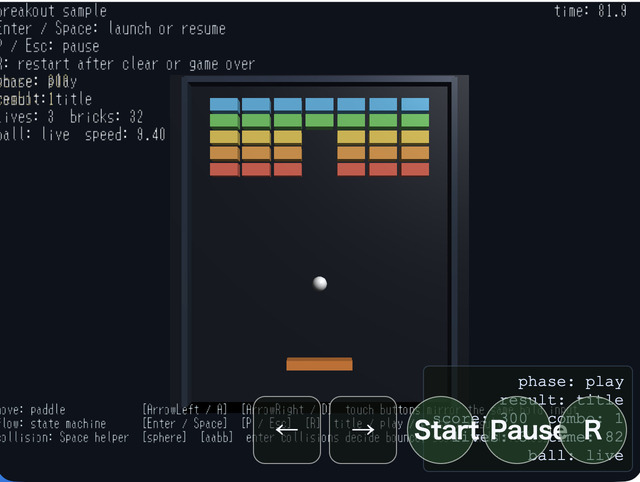
Overview
- This sample builds a simple breakout game with 3D presentation by using
webg’s basic game-oriented features
- It uses
WebgApp as the entry point and collects input, HUD, scene phase, game-state management, and display messages into a single processing flow
- The board progresses through four states,
title / play / pause / result, and switches naturally according to input, remaining bricks, remaining time, and remaining lives
- The appearance is close to 2D, but the game is built by generating
Paddle / Ball / Brick / Wall as 3D shapes and combining them with 2D-like coordinate management
- The
Message-based HUD shows score, combo, time, lives, phase, and ball state so the game flow can be followed from on-screen information alone
- Touch buttons for left / right movement and
Start / Pause / R are provided so the same game actions can be performed through both keyboard and touch input
How to Run
- Open ./breakout.html
- Use a browser with WebGPU support, and check the help panel and HUD together with the sample when needed
webg Features Used
WebgApp: initializes Screen / Shader / Space / Input / Message / HUD / debug tools together- Sample-side
GameStateManager: organizes state transitions for title / play / pause / result
InputController: gathers normalized key names from keyboard and touch input into action namesTouch: enters left / right movement and launch / pause / restart through touch buttonsShape: creates arbitrarily sized box shapes for the paddle, bricks, walls, backdrop, and related objectsPrimitive: generates the sphere mesh for the ballSpace: places each shape as a node and builds the 3D scene for displayMessage: displays guide rows, control rows, game HUD, and statusToast: displays temporary state notifications such as serve, pause, miss, and result
Implementation Characteristics
- Input is collected into
left / right / launch / pause / restart through app.registerActionMap()
left corresponds to ArrowLeft / A, and right corresponds to ArrowRight / Dlaunch corresponds to Enter / Space, pause corresponds to P / Esc, and restart corresponds to R- The touch buttons
← / → are treated as hold input and used for left-right paddle movement
- The touch buttons
Start / Pause / R are treated as action input and correspond to launch / pause / restart
- Collision shapes are also attached to
Ball / Paddle / Brick / Wall, but the actual game judgement in this sample is handled by the sample-side 2D checks using makeBox() and circleIntersectsBox()
- Ball movement divides one frame into multiple smaller steps so the ball is less likely to tunnel through walls or bricks even at high speed
- Paddle reflection changes direction according to where on the paddle the ball hits
- When the ball hits a brick, only one brick disappears and
score and combo are updated
- When the ball falls to the floor side,
lives decreases, and if lives remain the ball is returned to the paddle
- When all bricks are removed the game is cleared, when
lives reaches 0 it becomes game over, and when time reaches 0 it enters the result state as time up
Checkpoints
- Confirm that
Enter / Space moves the game from title to play and launches the ball from the paddle
- Confirm that
ArrowLeft / ArrowRight / A / D move the paddle immediately, and that the touch buttons ← / → produce the same movement
- Confirm that
P / Esc enters pause and that Enter / Space or P / Esc can return to play
- During play, confirm that when the ball hits the paddle the reflection direction changes according to the hit position
- Confirm that when the ball hits a brick, only one brick disappears and
score and combo are updated
- Confirm that the ball reflects from the left and right walls and from the ceiling
- Confirm that when the ball falls to the floor side,
lives decreases, and if lives remain the ball is returned to the paddle
- Confirm that removing all bricks, reaching
0 lives, or reaching 0 time enters the result state, and that R returns to the title state
- Confirm that the touch buttons
Start / Pause / R can also start, stop, resume, and restart just like the keyboard
- Confirm that the HUD displays
score / combo / time / lives / phase / ball state so the game progress can be followed
Controls
ArrowLeft / A: move the paddle leftArrowRight / D: move the paddle rightEnter / Space: start from the title screen, resume from pause, or launch the ball from the serve-wait state during playP / Esc: pause, or resume from pauseR: return from result to title- Touch button
←: move the paddle left
- Touch button
→: move the paddle right
- Touch button
Start: trigger the launch action
- Touch button
Pause: trigger the pause action
- Touch button
R: trigger the restart action
State Transitions
title: initial state. The level is initialized and the sample waits for a start inputplay: the state where the actual game progresses. It updates paddle movement, ball movement, reflection, brick destruction, and remaining timepause: paused state. Game progress stops, but paddle movement input can still be checkedresult: finished state. It displays the result of clear / game over / time up and waits for restart input
Notes
- As a minimal verification sample for game-oriented APIs, this sample prioritizes an easy-to-follow flow for state, input, HUD, and collision checks over flashy visuals
- The ball is created with
Primitive.sphere(), while the paddle, bricks, walls, and backdrop are created as arbitrarily sized box meshes through createBoxShape() inside the sample
- The ball uses a sphere collision shape, and the paddle, bricks, and walls use AABB collision shapes
- However, the collision test used for actual game progression uses the sample-side simplified 2D check
circleIntersectsBox()
- Nodes and collision bodies are registered in
Space, but in this sample it is used mainly as the foundation for placing game elements in a 3D scene
- The result screen groups
clear / game over / time up into the same phase and changes only the reason text
- Input processing assumes normalized key names and action names from the
WebgApp / InputController side through the input API